

Events, News, Publications
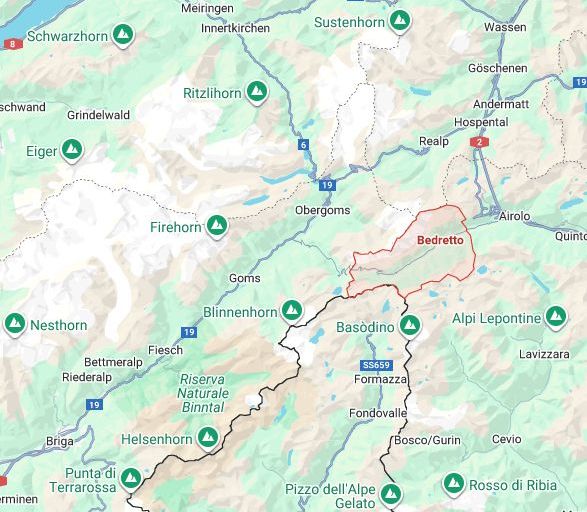
Under the Alps: Assessing the Potential of Bedretto for Particle and Astroparticle Physics
ETH visits to the Bedretto Underground Laboratory
Image: Google map
Uncle Scrooge discovers particle physics
Sometimes it takes a simple idea to get science concepts into children’s minds. When the world was in lockdown and parents everywhere juggled home schooling their kids, getting their own work done and keeping everybody happy and healthy, scientist Luigi Marchese thought back to his own childhood and had an idea. Why not combine what he loved as a child – reading comic books, especially the Italian “Topolino” magazine featuring Mickey Mouse, Donald Duck and co – and what he does as an adult – doing particle physics at the CMS detector – to keep kids edutained?
Image: Disney
Behind the Scenes of the Large Hadron Collider Upgrade
The Large Hadron Collider, or LHC, is a huge accelerator used by several detector collaborations with over 10,000 scientists to advance our understanding of fundamental physics. While we often cover news like the measurement of new particles or the precise determination of fundamental constants, today we would like to focus on the less visible work needed for the LHC detectors to function. We are speaking with Dr. Silke Möbius, a postdoctoral researcher, and Camilla Tognina, an electrical engineer, who are developing a read-out system for the new inner detector (Inner Tracker) of the ATLAS experiment. This project started in 2018 in the group of Professor Michele Weber at the University of Bern and involved in total 37 people at the various stages of the project.
Image: CHIPP
First CHIPP postdoc prize goes to PSI postdoc
Efrain P. Segarra awarded for his work on n2EDM
Image: CHIPP
Welcoming international students to Switzerland with S3P3
Simulations, shifts, chocolate and connections: next-generation particle physicists participate in Swiss Summer Student Particle Physics Program
Image: CHIPP
CHIPP prize 2025: Top precision for top quarks
University of Zurich graduate Chiara Savoini wins CHIPP PhD prize 2025
Image: CHIPP
The giant under the mountain
In a hole in the ground there lived… a detector, submerged in 260 million litres of ultrapure water. Sounds like the beginning of a great story? It probably will be in the future! For, to be precise the detector doesn’t live there yet; it needs to be built first. And it’s also not just any hole we are talking about: it’s one of the largest human-made caverns ever built (and thus nowhere near a cosy hobbit habitation). Excavation for it has just finished under Mount Nijugoyama in the Japanese Alps. Once complete and fully equipped, it will be home to a massively impressive neutrino detector: Hyper-Kamiokande. Swiss groups are holding the reins of many milestones and projects within the experiment collaboration.
Image: Kamioka Observatory, ICRR (Institute for Cosmic Ray Research), The University of Tokyo.
Muonic Ruler: Measuring Nuclei, Testing Fundamental Interactions
The radius of a helium-3 nucleus — made up of two protons and a single neutron — was recently measured with unprecedented precision by an international collaboration at the Paul Scherrer Institute (PSI). This measurement concludes a long series of experiments that use muonic atoms as a ruler. Together, these experiments help us better understand how particles interact inside nuclei
Image: CHIPP & PSI
Swiss Input to the European Strategy for Particle Physics 2026 Update
Advancing the Future of Discovery Science in Europe
Image: CHIPP